Clinical Trial

The Impact of Buoy on Hydration Status of Active Men and Women

University of Pittsburgh — Academic Medical Center

Clinical Trial NO: NCT05768789

Academic Medical Center Led
Placebo-Controlled
Crossover Design
Hydration Measured Over 6 Hours
The Results

Buoy electrolytes are clinically-proven to be:

64%

More Hydrating

Than Water Alone

49%

More Hydrating

Than Leading Electrolyte Competitor

~10x

Positive Fluid Balance

Increase Compared to Both

Key Findings

This study measured key hydration biomarkers in blood and urine alongside two universal standards to measure stable, all-day hydration.

(1) Buoy increases Net Fluid Balance

Compared to water alone and a leading electrolyte

Fig 1a: Net Fluid Balance

Buoy significantly increases positive fluid balance compared to water alone or a leading electrolyte competitor at just 3 hours through 6 hours.

**Our clinical study shows that at 4 hours, water alone is more hydrating than a leading competitor and at 6 hours the difference between the two are negligible.

Fig 1b: Net Fluid Balance

Buoy significantly increases positive fluid balance compared to water alone or a leading electrolyte competitor at just 3 hours through 6 hours.

**Our clinical study shows that at 4 hours, water alone is more hydrating than a leading competitor and at 6 hours the difference between the two are negligible.

(2) Buoy increases the Beverage Hydration Index

Compared to water alone and a leading electrolyte

Fig 2a: Beverage Hydration Index — Buoy compared to Water Alone

Buoy significantly increases the Beverage Hydration Index compared to water alone at every interval over the entire study.

Fig 2b: Beverage Hydration Index — Buoy compared to Leading Electrolyte Competitor (with water as baseline)

Buoy significantly increases the Beverage Hydration Index compared to a leading electrolyte competitor. A leading electrolyte competitor is essentially tied with water alone at the six hour mark, showing no significant advantage over water.

(3) Buoy decreases urine output

Compared to water alone and a leading electrolyte

Fig 3: Cumulative Urine Volume

Buoy significantly reduces urine output leading to higher fluid and electrolyte retention.

(4) Buoy increases urine osmolarity

Compared to water alone and a leading electrolyte

Fig 4a: Cumulative Urine Osmolarity — 360 Minutes’

Buoy significantly increases urine osmolarity compared to water alone. Water alone dilutes urine while Buoy concentrates it with electrolytes. Fig 3 above shows Buoy’s increases retention of fluids while Fig 4a and 4b show Buoy’s increase in concentrated urine with electrolytes.

Fig 4b: Cumulative Urine Osmolarity — 360 Minutes’

(5) Buoy retains more electrolytes (sodium, potassium, chloride)

Compared to water alone

Fig 5a: Cumulative Na (Sodium) Volume in urine

You are losing more electrolytes (sodium) in your urine when you drink water-alone compared to Buoy.

Fig 5b: Cumulative K (Potassium) Volume in urine

You are losing more electrolytes (potassium) in your urine when you drink water-alone compared to Buoy.

Fig 5c: Cumulative Cl (Chloride) Volume in urine

You are losing more electrolytes (chloride) in your urine when you drink water-alone compared to Buoy.

Clinical Study Highlight

Our clinical study highlights delayed rehydration from:

(1) Bolus Ingestion of water and/or electrolytes

How other electrolytes dose their serving sizes

Our bodies induce a physiological response against bolus water intake or bolus electrolyte ingestion to protect against low blood salt and high blood salt, respectively.


(2) diuretics: Most sweeteners and sugar alternatives

Sugar alternatives like stevia and artificial sweeteners are diuretics

Studies showing: Stevia Has Diuretic Properties

Arumugam B, Subramaniam A, Alagaraj P. Stevia as a Natural Sweetener: A Review. Cardiovasc Hematol Agents Med Chem. 2020;18(2):94-103. doi: 10.2174/1871525718666200207105436. PMID: 32031079.

Studies showing: Artificial Sweeteners Has Diuretic Properties

Ringel NE, Hovey KM, Andrews CA, Mossavar-Rahmani Y, Shadyab AH, Snetselaar LG, Howard BV, Iglesia CB. Artificially sweetened beverages and urinary incontinence-a secondary analysis of the Women's Health Initiative Observational Study. Menopause. 2023 Mar 1;30(3):283-288. doi: 10.1097/GME.0000000000002129. Epub 2022 Dec 13. PMID: 36515559; PMCID: PMC9974739.

Buoy’s Approach to Hydration

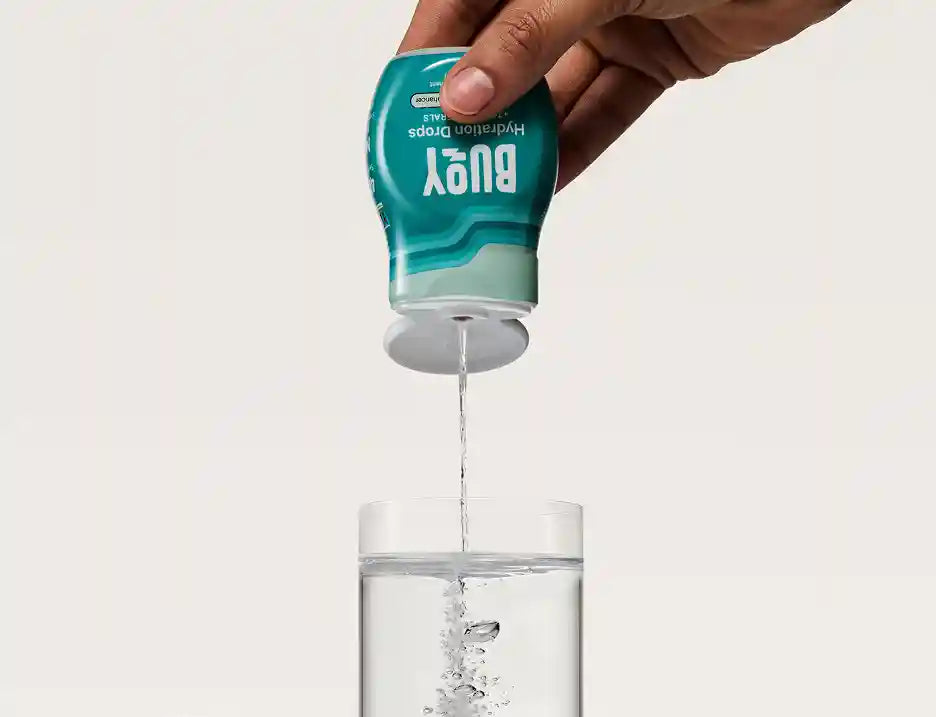
Buoy’s purposefully unflavored, naturally-harvested and naturally-balanced approach to hydration outperforms water alone and a leading electrolyte competitor.

No Sugar, Sweeteners or Flavors
Highly Bioavailable Form Factor
Naturally-Balanced Electrolyte Ratios
Ocean Harvested Electrolytes
87+ Ionic Trace Minerals
Vegan
Non-GMO Project Verified
Keto & Paleo Approved
Third Party Tested
100% Microplastic Free