






The Gut-Brain-Hydration Triangle: What New Research Reveals
For years, hydration was viewed as a body-only function. Drink more water, feel better, move on. But the more recent research shows hydration runs much deeper. It affects not just your cells, but your gut and brain, working as part of a three-way feedback loop scientists now call the gut-brain-hydration connection.
This connection changes how we think about electrolytes. It’s not just about replacing what you sweat out; it’s about how your gut senses hydration, how your brain interprets those signals, and how your cells use that information to maintain balance.
Key Takeaways
- The gut-brain-hydration connection explains why hydration affects both digestion and mental clarity.
- Your gut helps your brain track hydration through neurons that sense how salty or diluted your digestive fluids are [1][2][3].
- Proper electrolyte balance ensures accurate hydration signaling and nutrient absorption.
- The gut microbiome plays a major role in how efficiently you rehydrate [4][5][6].
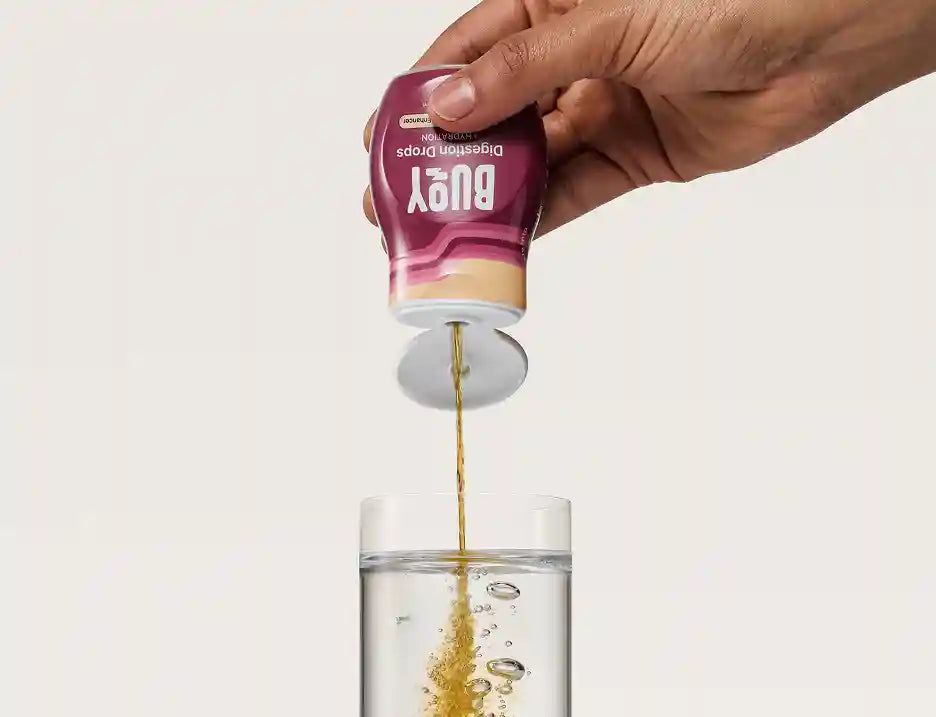
That’s why Buoy’s Digestion Drops were designed to support more than hydration. They’re formulated to nurture the gut and keep the brain’s communication lines clear.
- Understanding the gut-brain-hydration Connection
- The Gut’s Surprising Role in Hydration
- Why Gut Health Shapes How You Hydrate
- The gut-brain-hydration Balance
- Electrolytes and Osmoregulation: How Your Body Balances It All
- Why The Gut-Brain Axis Depends on Hydration
- How Buoy’s Digestion Drops Support the gut-brain-hydration Connection
- Hydration, Mood, and Focus: The Missing Link
- What the Research Says (In Plain English)
Understanding the gut-brain-hydration Connection
Your gut and brain talk to each other constantly. Through a network called the gut-brain axis, they share information about digestion, stress, and hydration levels via nerves, hormones, and neurotransmitters [4][5].
The gut sends updates to the brain about what’s entering your system, including nutrients, water, and electrolytes, and then the brain adjusts digestion, thirst, and metabolism accordingly. When hydration dips, the brain triggers sensations of thirst, fatigue, or brain fog as a way to restore equilibrium.
But this process only works if your gut and brain are both functioning well. That’s where electrolytes, and especially clean electrolyte sources, come in.
The Gut’s Surprising Role in Hydration
Recent research shows the gut isn’t just along for the ride,it actually helps regulate thirst signals to the brain
In a 2019 study from Columbia University and the National Heart, Lung, and Blood Institute, scientists discovered that specialized gut neurons detect changes in the osmolarity of the fluids you drink and send real-time updates to the brain’s thirst center [1][2]. This means your gut can tell your brain you’ve had enough to drink, even before that water reaches your bloodstream
A Caltech study found that signals travel along the vagus nerve, where sensors in the gut detect salt and fluid levels and alert the brain to adjust hydration [3].
This explains why some people feel “off” even after drinking plenty of water. Without the right electrolyte balance, your gut can’t send the right hydration signals to your brain.
Why Gut Health Shapes How You Hydrate
The trillions of bacteria living in your gut help control how well you absorb water and nutrients. When your gut lining is healthy, it efficiently moves water and electrolytes into the bloodstream. But inflammation, stress, or poor diet can disrupt that balance, leading to bloating, dehydration, and sluggish digestion [4][5].
Hydration isn’t just about volume. It’s about absorption. If your gut is struggling, you can drink all the water you want and still feel dehydrated.
Electrolytes like sodium and potassium pull water through your intestinal walls, helping move fluid from your gut into your bloodstream. When you use clean electrolytes that mimic the body’s natural balance, hydration becomes more efficient.
That’s what Buoy’s Digestion Drops are built for: clean, balanced electrolytes that support gut lining integrity while restoring hydration from the inside out.
The gut-brain-hydration Balance
|
Category |
Buoy Digestion Drops |
Typical Electrolyte Powders or Sports Drinks |
|
Gut Health Support |
Contains balanced electrolytes that aid digestion and electrolyte absorption. |
Often overloaded with sugar or artificial sweeteners that can irritate gut bacteria. |
|
Electrolyte Spectrum |
Sodium, potassium, magnesium, chloride, and trace zinc mimics natural plasma ratios. |
Usually limited to sodium and potassium, missing key trace minerals. |
|
Additives |
No sugar, dyes, or artificial flavors. |
Includes sweeteners, stabilizers, or coloring agents. |
|
Hydration Feedback Efficiency |
Supports gut–brain signaling via optimal osmolality. |
High-sugar formulas can delay water absorption and skew thirst signals. |
|
Clean Label Status |
Transparent ingredients and third-party testing. |
Many hide formulations under “proprietary blends.” |
Electrolytes and Osmoregulation: How Your Body Balances It All
Osmoregulation simply means keeping water levels balanced. Electrolytes do the job of keeping that balance steady.
When sodium levels fall too low (hyponatremia), the brain receives delayed or inaccurate thirst cues. Too much sodium (hypernatremia) pulls water from cells, triggering dehydration symptoms. Potassium and magnesium counterbalance sodium, helping maintain proper nerve function and digestive motility [1][6].
This back-and-forth is part of what researchers now call the gut-brain-hydration triangle. Every sip you take triggers a cascade of signals from your gut detecting osmolarity changes, to your brain deciding whether to keep or release water, to your kidneys fine-tuning electrolyte output.
Buoy’s Digestion Drops are designed to work harmoniously with this system. By delivering electrolytes in their cleanest form without sugar or additives,, they support smooth hydration signaling, healthy digestion, and mental clarity.
Why The Gut-Brain Axis Depends on Hydration
Your gut and brain use neurotransmitters like serotonin, dopamine, and acetylcholine to communicate. In fact, about 90% of serotonin - the “feel-good” chemical - is made in your gut [4].
When you’re dehydrated, your gut can’t keep the right balance of electrolytes, and that slows the movement of mood-related signals between gut and brain [5][7]. The result? Brain fog, irritability, and slowed digestion.
A 2023 study from the University of Illinois found that hydration status directly affects mood regulation and gut-brain signaling speed [6]. When hydration improved, so did the participants’ focus and digestive comfort.
The takeaway: proper hydration doesn’t just keep you physically balanced It keeps your mental and digestive systems talking smoothly.
How Buoy’s Digestion Drops Support the gut-brain-hydration Connection
Clean hydration starts with clarity. No sugar, no fillers, no mystery ingredients. Buoy’s Digestion Drops give your body the minerals it needs to balance fluid movement, digestion, and cognitive clarity.
Here’s how:
- Sodium and potassium help regulate fluid transport in and out of gut cells.
- Magnesium supports muscle contractions that move food through your intestines.
- Zinc helps maintain gut lining integrity.
- Chloride aids in producing stomach acid for digestion.
Together, they reinforce the natural feedback loop between your gut and brain, keeping hydration signals accurate and digestion steady.
Unlike powdered drinks or flavored packets, Buoy delivers these electrolytes in a clean liquid format, free of sugar or artificial flavoring. That means faster absorption, no gut irritation, and better communication between the systems that control hydration.
Hydration, Mood, and Focus: The Missing Link
It’s not all in your head. Hydration really does affect how you think.Even mild dehydration - just a 1 – 2 % drop in body weight -can make it harder to focus and can affect mood [7].
The gut-brain axis is highly sensitive to these changes. When your gut senses fluid loss, it releases hormones that influence alertness and energy regulation. Electrolyte-driven hydration helps buffer this system, maintaining steady brain function even during stress or mild dehydration.
That’s why many Buoy users notice not only better digestion, but also sharper focus and improved mood throughout the day. Hydration is the foundation. The gut-brain connection is the amplifier.
What the Research Says (In Plain English)
Scientists now see hydration as more than a mechanical process. It’s a bi-directional dialogue between the gut, the brain, and the body’s cells:
- The gut senses what’s coming in. Its saltiness, volume, and composition.
- The brain interprets those signals to decide thirst, focus, and fluid retention.
-
Electrolytes translate that conversation, ensuring both systems stay in sync.
Without clean electrolytes, this conversation breaks down. That’s where Buoy’s formulation closes the gap: a minimal-ingredient solution built to support every side of the triangle.
References:
- Zimmerman, C.A., et al. A gut-to-brain signal of fluid osmolarity controls thirst satiation. PMC. 2019. https://pmc.ncbi.nlm.nih.gov/articles/PMC6483081/
- “Your gut controls your thirst and keeps your brain informed.” National Heart, Lung, and Blood Institute News Release. March 30, 2019. https://www.nhlbi.nih.gov/news/2019/your-gut-controls-your-thirst-and-keeps-your-brain-informed
- Ichiki, T., Wang, T., et al. How gut neurons communicate with the brain to control thirst. Caltech Experts. 2022. https://experts.caltech.edu/news/how-gut-neurons-communicate-with-the-brain-to-control-thirst
- Mittal, R., et al. Neurotransmitters: The critical modulators regulating gut-brain axis. PMC. 2017. https://pmc.ncbi.nlm.nih.gov/articles/PMC5772764/
- Bliss, E.S., et al. The Gut-Brain Axis, the Human Gut Microbiota and Their Interactions. PMC. 2018. https://pmc.ncbi.nlm.nih.gov/articles/PMC6052131/
- Willis, N. Effects of hydration physiology on aspects of the gut-brain axis. University of Illinois. 2023. https://www.ideals.illinois.edu/items/128609
- Ashique, S., et al. Gut-brain axis: A cutting-edge approach to target neurological disorders. ScienceDirect. 2024. https://www.sciencedirect.com/science/article/pii/S2405844024101235